
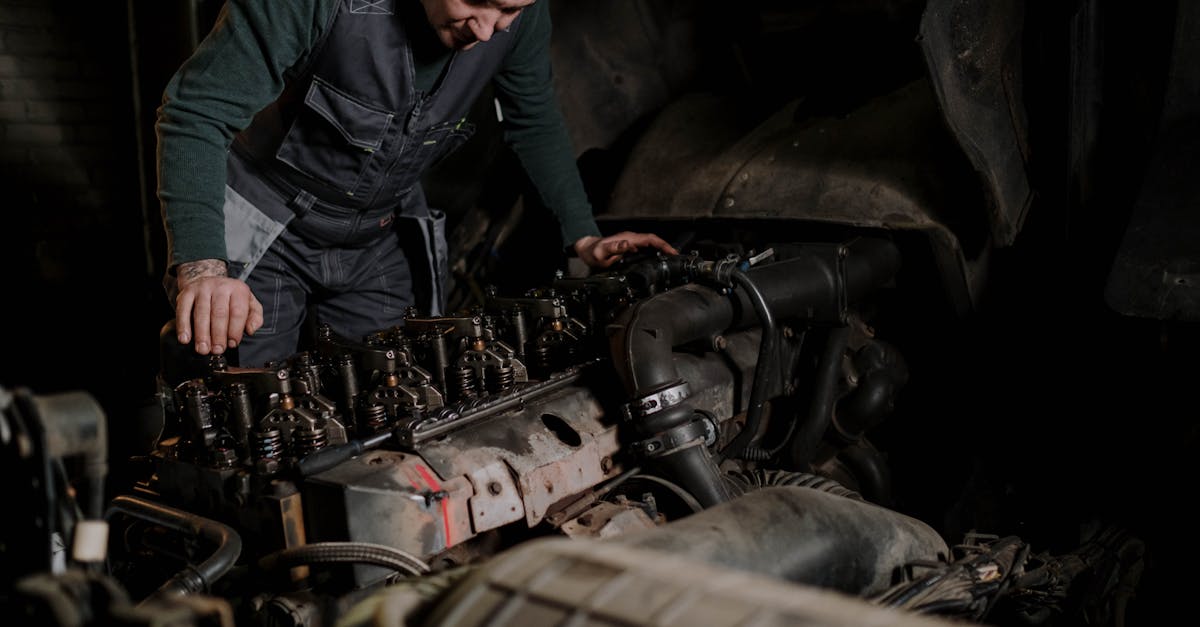
Diesel engines work by squeezing air so hard it gets hot enough to ignite fuel on its own — a process called compression ignition. There's no spark plug involved. Instead, the engine relies on heat, pressure, and precisely timed fuel injection to make power.
That one difference explains almost everything about how a diesel behaves: the deep torque, the knock at idle, the turbo whine, and the extra emissions hardware bolted to the back of the engine bay. This guide walks through the 4-stroke cycle, the fuel system, the turbo, and the emissions equipment — in plain language, without skipping the parts that actually matter for how you maintain the thing.
What Makes a Diesel Engine Different From a Gas Engine?
A gas engine mixes fuel and air, then uses a spark plug to light it. A diesel engine compresses air first — at a much higher ratio, usually 14:1 to 23:1 versus 8:1 to 12:1 for gas — then sprays fuel into that hot, compressed air. The heat from compression alone is enough to ignite it.
That's why diesels don't have spark plugs at all. If you want the deeper mechanical explanation, see Does a Diesel Engine Have a Spark Plug? (No — Here's What It Uses Instead).
This higher compression is also why diesel blocks, heads, and internal components are built heavier than gas engine parts. The engine has to survive far more cylinder pressure on every single stroke.
How Does the 4-Stroke Diesel Cycle Work?
Most diesel engines run a 4-stroke cycle, just like a gas engine — but each stroke does a different job.
- Intake: The piston moves down, pulling air (no fuel yet) into the cylinder through the open intake valve.
- Compression: The intake valve closes, and the piston moves up, squeezing that air into a tiny space. Compression alone pushes the air temperature above 1,000°F in most diesels.
- Power: Near the top of the stroke, the injector sprays a precise shot of diesel fuel into the superheated air. It ignites instantly, and the expanding gases drive the piston back down hard.
- Exhaust: The exhaust valve opens, and the piston pushes the spent gases out toward the turbo and exhaust system.
Compare that to a gas engine, where fuel and air get mixed during intake and a spark fires it during the power stroke. The diesel sequence — air first, fuel injected last — is the whole reason compression ignition works.
What Role Does the Fuel Injection System Play?
Timing and pressure are everything in a diesel. The fuel injection system has to deliver diesel fuel at exactly the right moment, in exactly the right amount, at pressure that can exceed 30,000 PSI on modern common-rail systems.
Here's the sequence on a typical common-rail diesel:
- A lift pump pulls fuel from the tank through the primary filter and water separator.
- A high-pressure pump (often a CP4 or CP3 on Ford/GM/Ram platforms) pressurizes fuel into a shared rail.
- Electronic injectors fire multiple times per cycle — sometimes 5-8 tiny pulses — controlled by the engine computer.
- The computer adjusts timing and quantity based on load, RPM, and temperature.
This is why fuel cleanliness matters so much on a diesel. Water or debris in that fuel system can score injectors and destroy a high-pressure pump fast, and a failed CP4 pump often sends metal shavings through the entire fuel system. Regular filter changes protect all of it — see the 6.7 Powerstroke Fuel Filter Service Guide for real-world intervals and costs. Fuel quality itself matters too; cetane rating affects how easily that fuel ignites under compression, which you can read more about in Diesel Fuel Explained: Cetane, Gelling and Storage Life.
Why Do Almost All Diesel Engines Have a Turbocharger?
A turbocharger uses exhaust gas — which is already leaving the engine anyway — to spin a turbine that forces more compressed air into the cylinders. More air means the engine can burn more fuel per cycle, which means more power without making the engine bigger.
Diesels lean on turbos harder than most gas engines because compression ignition depends on packing as much oxygen into the cylinder as possible. Many modern trucks run twin turbos or a variable-geometry turbo that adjusts vane angle based on RPM, giving strong torque at low RPM and still spooling for highway power.
This is also part of why diesel engines make peak torque so low in the RPM range — often 1,600-2,200 RPM — compared to gas engines that need higher RPM to hit peak torque.
How Does Diesel Emissions Equipment Fit Into the Picture?
Modern diesels burn cleaner than older ones, but that combustion process still produces particulate matter (soot) and nitrogen oxides (NOx). Since 2007-2010, EPA emissions standards have required diesel engines to run extra hardware to control both.
- DPF (Diesel Particulate Filter): Traps soot in the exhaust stream and burns it off periodically during a regen cycle.
- EGR (Exhaust Gas Recirculation): Routes some exhaust back into the intake to lower combustion temperature and reduce NOx.
- SCR with DEF (Selective Catalytic Reduction): Injects diesel exhaust fluid into the exhaust stream to chemically break down NOx before it exits the tailpipe.
Warning: Removing, deleting, or bypassing any of this equipment violates the federal Clean Air Act and can bring EPA fines plus state emissions inspection failures. A shop that offers a "delete" package instead of proper maintenance is trading a short-term power bump for long-term legal exposure — most states tie annual registration to a passing OBD emissions check, and a deleted truck will throw codes or fail the visual inspection almost every time.
Passive Regen vs. Forced Regen — What's Actually Happening Under the Truck
Soot loads the DPF gradually, and the truck deals with it two different ways depending on how full the filter is:
- Passive regen happens automatically, with no dash warning at all. It occurs any time exhaust temperatures climb above roughly 600°F for a sustained period — typically during steady highway driving under load. The extra heat oxidizes soot continuously, so the driver never notices it happening.
- Active (forced) regen kicks in once the engine computer estimates soot accumulation has reached about 45-50 grams. The ECM commands a late injection pulse after the normal combustion event, dumping extra fuel into the exhaust stream specifically to push DPF temperatures above 900-1,000°F and burn the trapped soot. This can happen while driving (you'll often notice a slightly rougher idle or a fan kicking on) or, if soot load is high enough, the truck may need to sit and idle for 20-40 minutes to complete it.
Decision framework: if the dash shows a regen-in-progress icon during normal driving, keep driving — interrupting it just restarts the count. If you get a solid DPF warning lamp with a noticeable power reduction, get the truck to highway speed for 15-20 minutes to trigger a passive regen, or have a shop run a forced regen with a scan tool. If soot load is reported above roughly 55 grams or the truck has already failed two forced regen attempts, a shop visit is required — at that point the filter usually needs to be pulled and baked or replaced rather than burned clean on the truck.
Typical shop costs: a scan-tool-forced regen runs $150-$300 in labor; removing and thermally cleaning a clogged DPF runs $600-$1,200; a full DPF replacement lands between $2,000-$3,500 depending on platform; an EGR valve replacement is usually $400-$900; and an SCR/DEF dosing module replacement runs $800-$1,800. Catching a clogged filter early with a shop-forced regen is almost always cheaper than letting it progress to a replacement.
Frequently Asked Questions
Need a Diesel Mechanic?
Tell us what's wrong and we'll match you with local shops that can take it on.
Find a Diesel Shop Near You


Discussion (0)
Be the first to comment!
Share your experience or ask a question about diesel repair.